
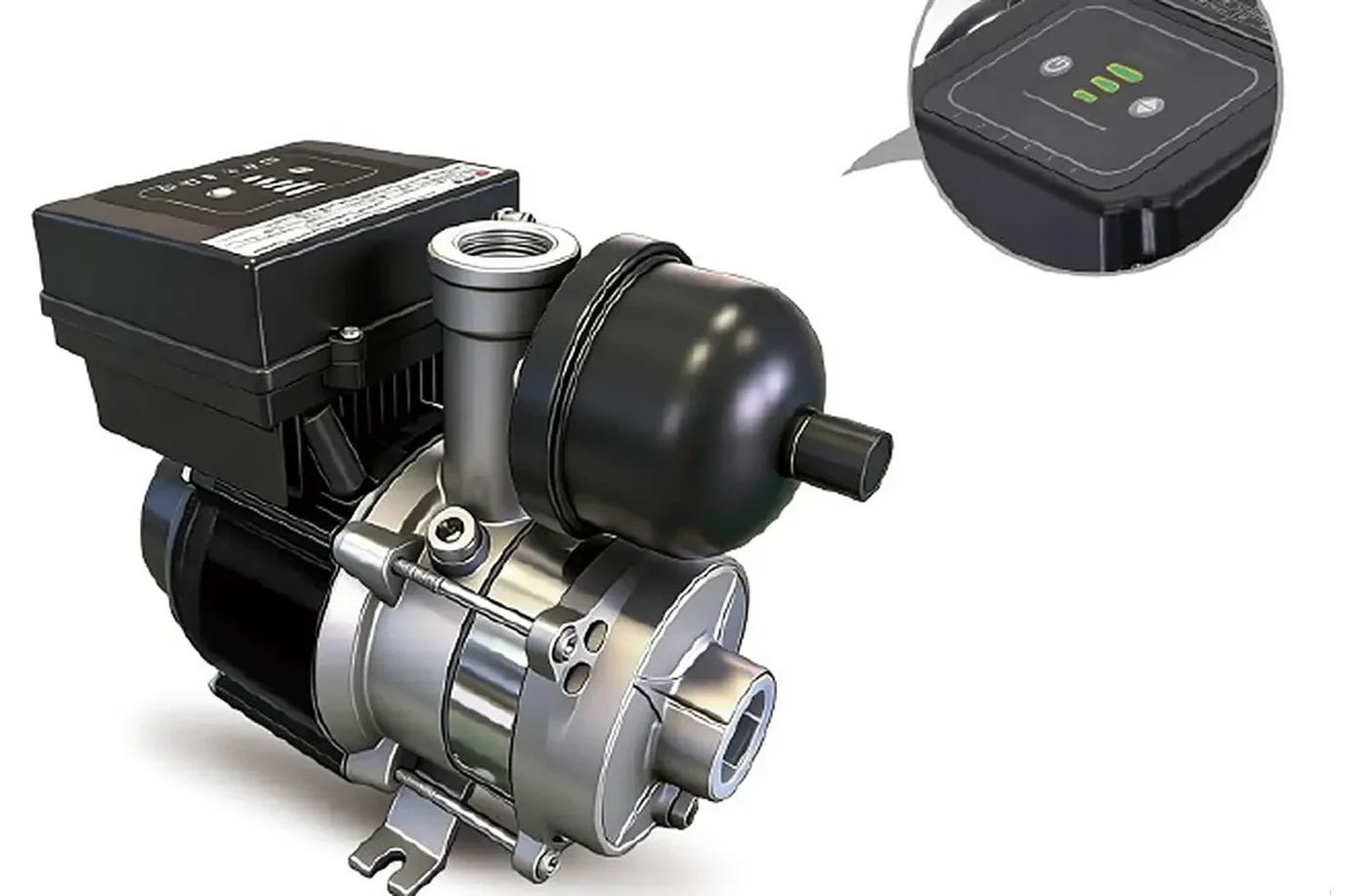
In many Philippine homes, water runs from a cistern to an overhead tank, then feeds the house by gravity. The upstairs shower gets a weak stream because gravity alone cannot push enough pressure to the top floor. An inverter booster pump installed between the tank and the house fixes this by holding a pressure set point. This guide covers the three numbers for a multi-storey home — lift and head, simultaneous flow, and the pressure setting — then matches them to a model.
Модели, использованные в качестве примеров в этой статье: SCS100P-3 многоступенчатый насос из нержавеющей стали с регулируемой частотой на постоянных магнитах and SPS90-3 повысительный насос vfd на постоянных магнитах, оба перечислены в однофазные многоступенчатые повысительные насосы из нержавеющей стали группе.
Storeys and head: how high the water must go
Each storey adds roughly 3 m of lift, so a three-storey house has its highest shower about 9 m above the pump. Head is the lift plus the friction the pipes add plus the pressure the highest outlet needs, and 1 bar is about 10.2 m of water column. For a VFD booster, the outlet pressure is the constant-pressure set point, so the required head is the set point plus lift plus friction. If the pump is fed from a pressurised mains line rather than a tank, the inlet pressure counts toward the total and the pump only has to add the difference.
Simultaneous flow: count what runs at the same time
Flow is the volume the site must deliver at the same moment, not the total of everything connected. A three-storey house with four taps, two showers and a washing machine rarely runs them all at once, so size for the realistic peak: the outlets that are actually open together at the busiest time of day, for example two showers plus a kitchen tap.
Write the peak down in litres per minute. An inflated flow figure is the most common sizing mistake: it pushes the selection to a larger pump that then runs throttled, noisy and far from its best efficiency point.
Pressure setting: what the set point should be
The VFD holds the pressure set point by changing motor speed, so the set point is the pressure the highest outlet sees. Set it high enough to cover the top shower with margin, but no higher: extra pressure is turned into noise and wear rather than useful flow, and it stresses pipes and fittings. The installer sets the point on site against the duty the house actually needs, and it can be adjusted later if the household changes.
A pump running near its design duty is quieter and draws closer to its rated input than a pump throttled far from the curve. That is why the set point and the model are chosen together, not separately.
Model comparison: a worked example
Take a three-storey house whose peak demand is 40 L/min at 28 m of head. That is the duty point: 40 L/min, 28 m. Here is how three models compare against it, using their published Q-H curves.
- SPS-90, ступень 5 (0,38 кВт): опубликованная кривая идёт от 32 м при нулевой подаче до 0 м при 60 л/мин, проходя 25,9 м при 30 л/мин и 15,9 м при 45 л/мин. При 40 л/мин он даёт около 19 м — ниже требуемых домом 28 м. SPS-90 не покрывает эту рабочую точку.
- ICP100F (0,75 кВт): опубликованная кривая идёт от 38 м при нулевой подаче до 10 м при 87 л/мин, проходя 32 м при 34 л/мин и 29 м при 47 л/мин. При 40 л/мин он даёт около 30,6 м — выше требуемых 28 м, с запасом около 2,6 м. ICP100F покрывает рабочую точку.
- SCS100P-3, мощность 1 (0,55 кВт): уже самая низкая из пяти ступеней мощности достигает 115 л/мин при напоре до 46 м, а её кривая мощности 5 проходит около 63 м при 40 л/мин. Она покрывает рабочую точку с гораздо большим напором, чем нужно дому, поэтому для этой рабочей точки насос слишком большой — лишний напор пришлось бы дросселировать.
- Вывод: ICP100F подходит. Он покрывает рабочую точку ближе к середине своей кривой, тогда как SPS-90 не дотягивает, а SCS100P-3 — больше насоса, чем дом может использовать.
Voltage and water source checks
A pump that covers the duty point still fails if the site cannot power it or feed it. Philippine homes run on 220V / 60Hz, so confirm the nameplate voltage and frequency against the supply before ordering. Then check the water source: a pump fed from a cistern below the pump works on suction lift, so priming and dry-run protection matter, and the suction pipe should be short, fitted with a strainer and a non-return valve, and free of high points that trap air. If the source is an overhead tank above the pump, the inlet is flooded and suction lift does not apply.
Следующие шаги
Work through the selection guide for a shortlist, then open a model page for the full specification and the Q-H curve. Send the three numbers — flow, head and voltage — with the inquiry, and our team confirms the model and replies with a quotation.
Готовы указать спецификацию? Отправьте подачу, напор, питание и размер трубы через форма запроса , или напишите экспортной команде в WhatsApp .