
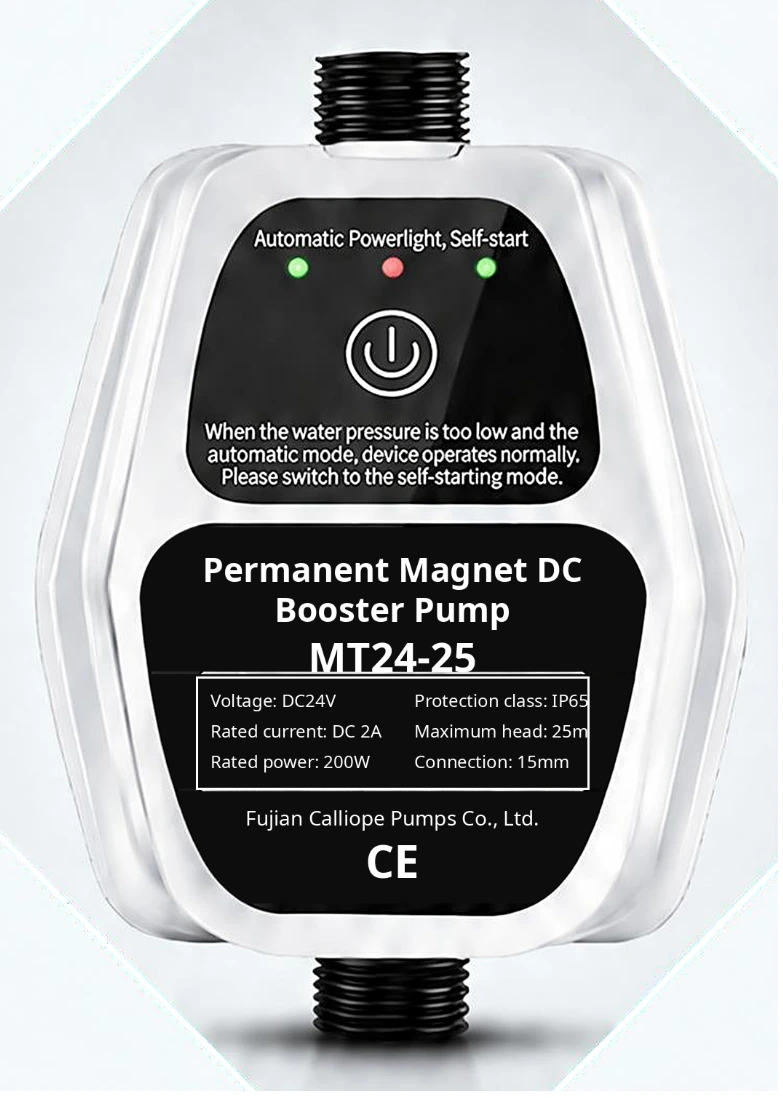
Off the grid, there is no mains supply to plug a pump into — so the pump has to run from the power you can generate on site. A DC 24 V pump runs from low-voltage direct current, which is what a solar panel produces and what a battery stores. That makes the DC range a natural match for solar pumping. This article explains what DC 24 V means, how solar-direct and battery setups work, where off-grid pumping fits, and the checks to run before you buy.
Các model được dùng làm ví dụ trong bài viết này: MT24-25 bơm tăng áp dc thông minh and ISC-200 bơm tăng áp thông minh áp suất không đổi, cả hai đều được liệt kê trong bơm tăng áp đường ống dc nhóm.
What DC 24 V means
DC 24 V is low-voltage direct current. The DC range runs from a 24 V supply, and where mains power is available the same models can run through an adapter that takes AC 110 V or 220 V input. Low voltage is the point: the pump, the wiring and the battery all stay in the low-voltage range, which keeps the installation simple and safe to handle.
Do not confuse a DC 24 V pump with a high-voltage DC solar pump. High-voltage DC solar pumps run from a string of panels at hundreds of volts and need a specialist solar inverter. A DC 24 V pump is a different class of equipment: it runs from a 24 V battery or a 24 V solar controller, and it is sized for pipeline boosting and small-scale water supply rather than large irrigation duty.
Solar-direct or battery
There are two ways to feed a DC 24 V pump from solar power, and the choice decides when the pump can run.
- Solar-direct: the panels feed the pump through a controller, and the pump runs while the sun shines. It is the simplest setup, with no battery to buy or maintain, but the pump stops when the sun goes down or behind cloud.
- Battery: the panels charge a battery, and the battery feeds the pump. The pump can run at night and through cloudy periods, and the battery smooths out short dips in sunlight. It costs more and the battery needs replacing over time, but it gives water on demand rather than only when the sun shines.
Where off-grid pumping fits
The DC range covers pipeline boosting duty rather than whole-house duty: hot water areas, taps, and RV or caravan water lines. Off the grid, that duty shows up in farms, rural homes, cabins and mobile setups, where the water source is a tank and the pump boosts pressure in the line rather than lifting a whole house supply.
For a farm or a rural home, the usual layout is a tank or a well feeding the pump, and the pump boosting the line to the house or the field taps. For an RV or a caravan, the pump draws from the onboard tank and keeps the taps and shower at a steady pressure. In both cases the duty is modest flow at moderate head, which is what the DC range is built for.
Sizing for solar
Size the pump first, then the power to match it. Start with the duty point — the flow and head the site needs — and pick the model that covers it. Only then work out the panels and battery: the panels must cover the pump's running power plus charging, and the battery must cover the hours the pump runs without sun.
The common mistake is to size the panels first and the pump second. A panel array that cannot feed the pump at its duty point leaves the pump starved, and a battery that is too small leaves the pump stopping halfway through the evening. Work from the duty point outward, and confirm the panel and battery sizing with the solar supplier before ordering the pump.
What to check before buying
A DC 24 V pump is simple to install, but four checks still matter.
- Voltage: confirm the pump is a 24 V model and the controller or battery matches it. A 24 V pump on a 12 V supply will not reach its duty point.
- Controller: confirm the solar controller is rated for the pump and the panels, and that it protects the pump against dry running.
- Cable: keep the cable between the battery or controller and the pump short, and size it for the current. Long, thin cables drop voltage and the pump loses performance.
- Warranty: DC models carry a 1-year warranty, while single-phase models carry 2 years. Confirm the period in writing before ordering.
Các bước tiếp theo
Work through the selection guide for the duty point, then open the DC model pages for the full specification. Send the duty point, the power setup — solar-direct or battery — and the cable length, and our team confirms the model and replies with a quotation.
Sẵn sàng chốt thông số? Gửi lưu lượng, cột áp, nguồn điện và cỡ ống qua biểu mẫu yêu cầu , hoặc nhắn tin cho đội xuất khẩu qua WhatsApp .